Eldris data · EPR
Where the sellers on Amazon's EU marketplaces are based, 2026
Published · Last updated · Data: The Sellers Index, counted (CSV) · Tables and chart: CC BY 4.0
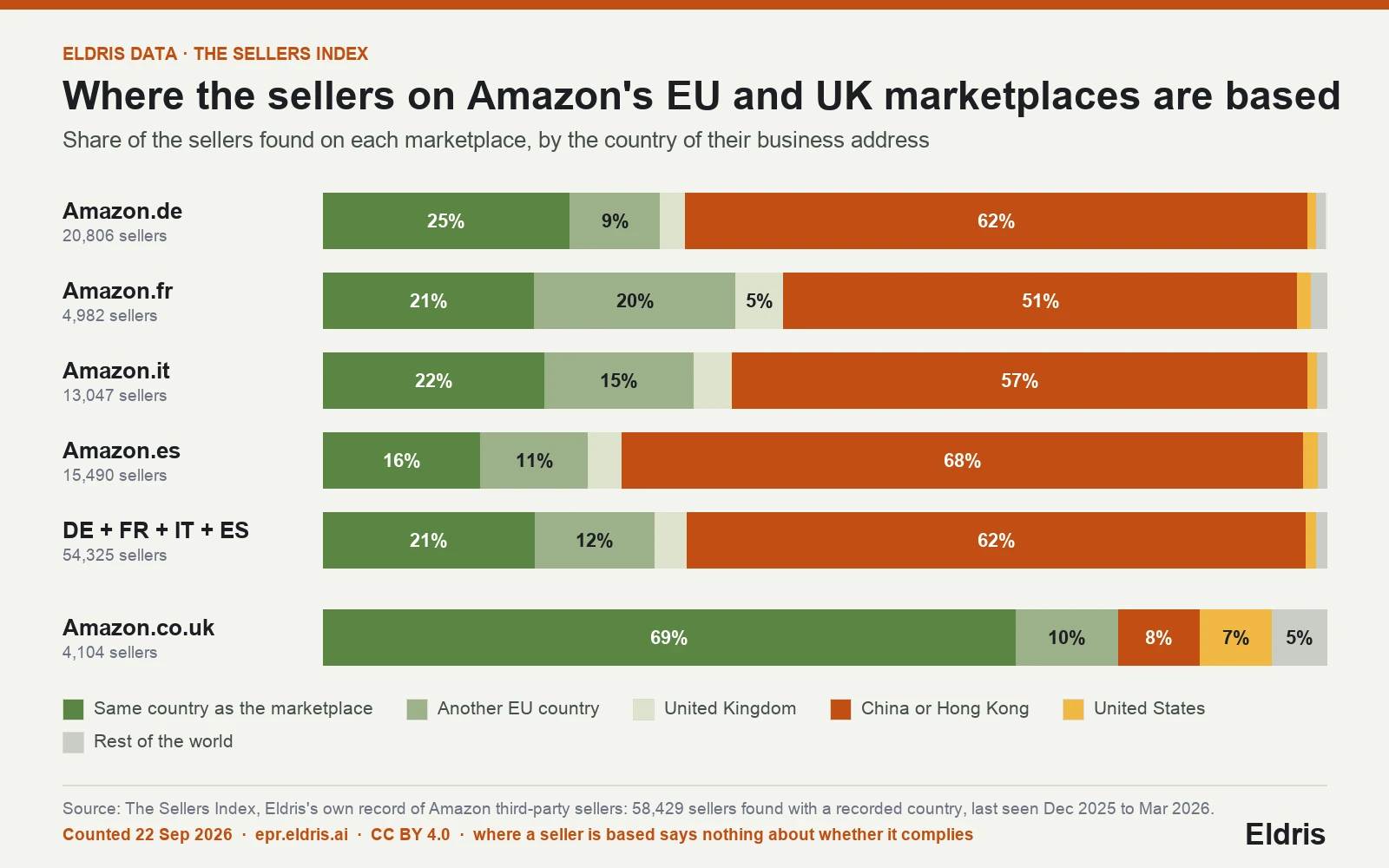
Of the 54,325 sellers with a recorded country that The Sellers Index found on Amazon.de, Amazon.fr, Amazon.it and Amazon.es, 66.9% had a business address outside the EU and 61.6% were based in China or Hong Kong (last seen December 2025 to March 2026). Only 21.2% were based in the country of the marketplace they were found on.
Your EPR price, by email
What would EPR registration cost you?
Two questions. The price appears as you choose, from the same price list as our quote tool. We email you the full quotation as a PDF.
£1,685 first year
then £1,310 a year
Germany, France, Italy, Spain · Packaging
- 5% multi-country discount applied: you save £90
- Spain: Spanish NIF one-off added (no existing Spanish NIF/VAT).
- Reporting for the year is included. Third-party scheme and authority fees are passed on at cost, never marked up.
Get my exact price Packaging price by country
A seller that sells packaged goods to consumers in an EU country where it is not established is a producer there: it registers in that country and appoints an authorised representative there. The figures say where sellers are based. They say nothing about whether any seller complies.
66.9%
of the 54,325 sellers found on Amazon DE, FR, IT and ES are based outside the EU
61.6%
of those sellers are based in China or Hong Kong
78.8%
are based outside the country of the marketplace they were found on
30.9%
of the 4,104 sellers found on Amazon.co.uk are based outside the UK
By marketplace
Share of the sellers found on each EU marketplace, by where their business address is. A business that sells packaged goods to consumers in an EU country from another country is a producer there and registers there (Regulation (EU) 2025/40, Article 3(1)(15)).
| Marketplace | Sellers | Same country | Other EU | UK | China or Hong Kong | US | Elsewhere | Outside the EU |
|---|---|---|---|---|---|---|---|---|
| Amazon.de | 20,806 | 24.6% | 9.0% | 2.5% | 62.0% | 0.9% | 1.0% | 66.4% |
| Amazon.fr | 4,982 | 21.0% | 20.1% | 4.7% | 51.2% | 1.3% | 1.5% | 58.8% |
| Amazon.it | 13,047 | 22.1% | 14.9% | 3.8% | 57.4% | 0.9% | 0.9% | 63.0% |
| Amazon.es | 15,490 | 15.7% | 10.7% | 3.3% | 68.0% | 1.4% | 0.8% | 73.6% |
| All four | 54,325 | 21.2% | 11.9% | 3.2% | 61.6% | 1.1% | 1.0% | 66.9% |
Amazon.co.uk
| Marketplace | Sellers | UK | EU | China or Hong Kong | US | Elsewhere | Outside the UK |
|---|---|---|---|---|---|---|---|
| Amazon.co.uk | 4,104 | 69.1% | 10.2% | 8.2% | 7.2% | 5.4% | 30.9% |
By product category
The category is the Amazon category The Sellers Index files each seller under, grouped. Electronics and computers are where WEEE and battery registration usually come in; every category ships in packaging.
| Amazon.de, .fr, .it and .es | Sellers | Same country | China or Hong Kong | Outside the EU |
|---|---|---|---|---|
| Beauty | 5,630 | 22.4% | 58.5% | 64.6% |
| Electronics and computers | 9,625 | 17.0% | 64.1% | 69.9% |
| Toys and games | 4,897 | 17.2% | 68.6% | 73.5% |
| All other categories | 34,173 | 22.7% | 60.4% | 65.5% |
Where the sellers from outside the EU are based
The largest countries outside the EU among the 54,325 sellers found on the four EU marketplaces, as a share of all of them.
| Based in | Sellers | Share of all four marketplaces |
|---|---|---|
| China | 32,387 | 59.6% |
| United Kingdom | 1,759 | 3.2% |
| Hong Kong | 1,087 | 2.0% |
| United States | 603 | 1.1% |
| Switzerland | 100 | 0.2% |
| India | 95 | 0.2% |
| Taiwan | 53 | 0.1% |
| Türkiye | 46 | 0.1% |
What sellers ask Eldris to register
Counted from Eldris's quote tool and client portal on . How this was measured
- 302
- priced EPR quotes created from 4 June 2026 to 24 September 2026
- 52%
- of them (157) created in August 2026, the month the EU Packaging Regulation began to apply (12 August)
- 80%
- of the registration streams sellers chose were packaging: 139 of 173, across 145 country registrations in the client portal
- 21.5 days
- median from payment to registration, over the first 6 completed country registrations (n = 6, all packaging)
Which EPR rules apply to a seller based elsewhere
Packaging. A business established in another member state or outside the EU that sells packaged products directly to consumers in a member state is a producer there (Regulation (EU) 2025/40, Article 3(1)(15)). It registers in each member state where it makes packaging available for the first time (Article 44(2)) and appoints, by written mandate, an authorised representative for extended producer responsibility in each of them other than its own (Article 45(3)). The Regulation has applied since 12 August 2026.
Electronics (WEEE). A business that sells electrical equipment at a distance directly to users in a member state, from another member state or a third country, is a producer there (Directive 2012/19/EU, Article 3(1)(f)(iv)), and is registered in that member state, through an authorised representative where it is not registered there itself (Article 16(1)).
Batteries. A business that sells batteries, including batteries inside appliances, at a distance directly to end users in a member state where it is not established is a producer there (Regulation (EU) 2023/1542, Article 3(47)(d)), registers there (Article 55(2)) and appoints an authorised representative for extended producer responsibility there (Article 56(3)).
The marketplace's check. Online platforms that let consumers buy from producers must obtain each producer's packaging registration details for the consumer's member state before allowing it to use their services (Regulation (EU) 2025/40, Article 45(4)).
The UK. The UK has its own rules. A seller selling into the UK from abroad through a marketplace is usually not the producer: the marketplace is, for electricals and for packaging supplied from outside the UK, and for batteries the UK importer is (UK EPR registration).
Quick answers
What share of the sellers on Amazon's EU marketplaces are based outside the EU?
Of the 54,325 sellers with a recorded country that The Sellers Index found on Amazon.de, Amazon.fr, Amazon.it and Amazon.es (last seen December 2025 to March 2026), 66.9% had a business address outside the EU and 61.6% were in China or Hong Kong. 21.2% were based in the country of the marketplace they were found on.
Does a seller based outside the EU need EPR registration in each EU country?
In each EU country where it sells packaged goods directly to consumers, yes: it is a producer there, registers there and appoints an authorised representative there for packaging (Regulation (EU) 2025/40, Articles 3(1)(15), 44(2) and 45(3)). Electronics and batteries are registered country by country too.
Where are the sellers on Amazon.co.uk based?
30.9% of the 4,104 sellers with a recorded country found on Amazon.co.uk had a business address outside the UK, and 20.7% outside both the UK and the EU.
Where does this data come from?
From The Sellers Index, Eldris's own record of Amazon third-party sellers. Eldris counted the 58,429 sellers carrying one of these five marketplaces and a recorded country, by the marketplace each was found on and the country of its business address. Only totals are published; no seller is named.
How this was measured
- Prices and times. The prices and average times to register in this page's tables and worked examples are read from the price list Eldris's checkout uses when the page is built, so they cannot drift from what you are charged. Line prices and average times last changed on ; annual reporting has been included in every price since . The times are the price list's averages, counted from receipt of your documents and signed power of attorney; they are not guarantees.
- Quotes. Priced EPR quotes created in the Eldris quote tool, table
epr_projects, counted on . Every priced quote the quote tool created, including repeat quotes from the same business. The table has no test flag, so a few internal test quotes may be included: read the count as an upper bound. August is 1 to 31 August 2026, UTC. - Streams. Registration streams chosen in the Eldris client portal, table
epr_project_countries, rows created from to . One row per country registration set up in the client portal, paid or not yet paid; one registration can carry several streams. The Spanish tax-number selections are fewer than 10 and are not shown on their own. - Time to register. Days from an order's payment to each country's registration: from the earliest payment on the order (table epr_payments) to the registration date recorded for the country (table epr_project_countries). Registrations completed from to . The clock starts at payment, so it includes the time taken to collect the seller's documents and signed power of attorney (the averages on the price list start when those are complete). Only the 6 country registrations completed by 26 September 2026 are counted, all of them packaging; registrations still in progress are not, so the median may rise as they complete. Too few to report by country or by stream.
- Source. The Sellers Index, Eldris's own record of Amazon third-party sellers (the figures as CSV; the same freeze is published on consult.eldris.ai). The whole table held 82,450 sellers. The tables here are the 58,429 of them that carry one of the five marketplaces and a recorded country, last seen between 4 December 2025 and 18 March 2026. Eldris counted them on .
- Marketplace. The Amazon marketplace on which The Sellers Index found the seller (one per seller). Sellers found on other marketplaces, or with none recorded, are not in these tables.
- Based in. The country of the business address recorded for the seller. Sellers with no recorded country are left out: Amazon.de 65, Amazon.it 36, Amazon.es fewer than 10, Amazon.co.uk 139.
- Categories. Beauty, electronics and computers, and toys and games are grouped from Amazon's category names, including their German, French, Italian and Spanish versions. Everything else is "All other categories".
- Privacy. Only totals are published. Counts of sellers under 10 are withheld and shown as "fewer than 10". No seller is named or can be identified.
- Limits of the seller data. It is the sample The Sellers Index collected, not a census of Amazon: read every share as "of the sellers found". The marketplaces were collected in different windows (Amazon.de December 2025 to February 2026; Amazon.fr January 2026 to March 2026; Amazon.it January 2026 to March 2026; Amazon.es February 2026 to March 2026; Amazon.co.uk December 2025 to February 2026). A seller that sells on several marketplaces is counted once, on the one where it was found. In the smaller set of 16,931 sellers enriched with contact details, 14.3% of its 9,578 seller-and-marketplace pairs on the four EU marketplaces are based outside the EU. That set is mostly sellers with a website, and in the main table sellers with a website are far more often based in Europe: 19.6% of the 15,253 with one are based outside the EU, against 85.4% of the 39,072 without. Where a seller is based says nothing about whether it complies with any rule.
- What these counts do not show. How many quotes became orders is not published here. Times by country or by stream are not published either: too few registrations have completed. Only totals are published; no customer, quote or order is identified.
The earlier Eldris seller pages
This page replaces the 13 "EPR Data Intelligence" pages published in June 2026. They used the smaller set of 16,931 sellers enriched with contact details, and their figures are superseded by the tables above. Their addresses now lead here.
Sources
- The Sellers Index: Eldris's own record of Amazon third-party sellers, counted 22 September 2026 (this page's figures as CSV; the same freeze on consult.eldris.ai)
- Eldris's quote tool and client portal, counted as described under How this was measured
- Regulation (EU) 2025/40 on packaging and packaging waste (PPWR) (EUR-Lex)
- Directive 2012/19/EU on waste electrical and electronic equipment (WEEE) (EUR-Lex)
- Regulation (EU) 2023/1542 on batteries and waste batteries (EUR-Lex)
- LUCID packaging register (Germany) · SYDEREP (France) · CONAI (Italy) · Registro de Productores de Producto, packaging (Spain)
- Check if you must comply with EPR for packaging (GOV.UK)