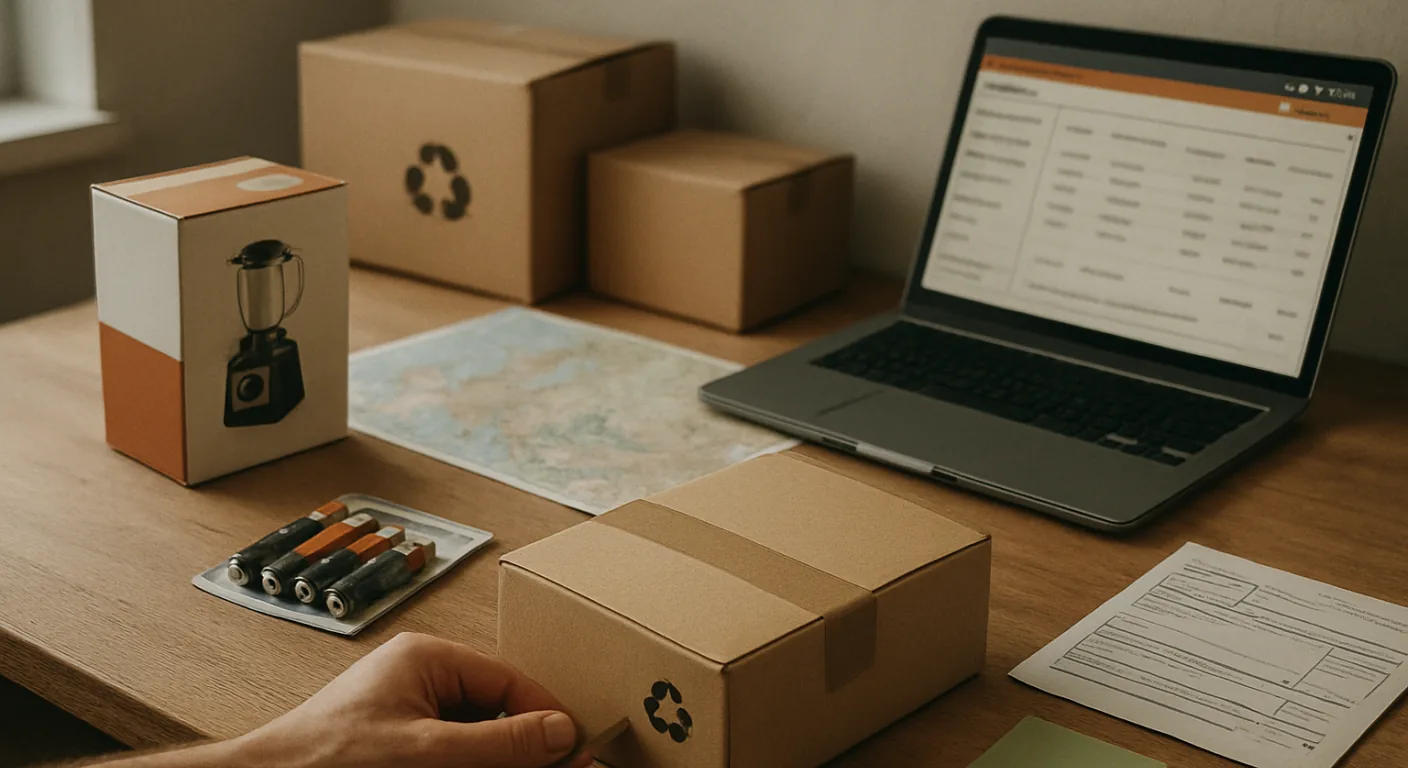
Do I need EPR registration at all, and who counts as the producer?
Summary
Yes, if you sell to end users in an EU country where your business is not established: you are the producer there for each stream you place on that market. Ex-works, business-to-business and buyer-as-importer cases are confirmed before you pay.
Your EPR price, by email
What would EPR registration cost you?
Two questions. The price appears as you choose, from the same price list as our quote tool. We email you the full quotation as a PDF.
Choose at least one country and one product type to see your price.
Yes, if your business sells to end users in an EU country where it is not established, through a marketplace or your own website. You are then the producer in that country for each stream you place on its market: packaging, electrical equipment and batteries, each registered separately. For packaging this follows from Regulation (EU) 2025/40, Articles 3(1)(15) and 44(2). If you sell ex-works, only to businesses, or with your buyer as importer, say so before you pay and Eldris confirms it. Eldris does not classify a product range inside a quotation.
When a sale into another EU country makes you the producer
Selling to end users in a member state from outside it makes you the producer there. The rule is the same for packaging, electrical equipment and batteries, but each stream has its own law, its own registration and its own number.
For packaging, a seller that sells directly to consumers in a country from another country makes its packaging available there for the first time. That makes it the producer in that country. It registers in that country, under Regulation (EU) 2025/40, Articles 3(1)(15) and 44(2). Electrical equipment sold at a distance to end users there counts in the same way under Directive 2012/19/EU, Article 3(1)(f)(iv). Batteries follow Regulation (EU) 2023/1542, Article 3(47)(d). The sales channel does not change this: a marketplace listing and your own website are treated alike. Nor does one registration travel. A German registration does not cover France, and a packaging number does not cover the batteries in the same box. A business established in the country is a producer too, when it first supplies the goods there. For the background, read what extended producer responsibility means; for electronics alone, the guide to WEEE producer status goes further.
Sales to businesses, ex-works terms and the importer of record
When your buyer imports the goods, the obligation usually follows the importer of record, and a local distributor that imports can take it on. Whether that applies to you depends on the details, so Eldris confirms it before you pay.
Most business-to-business questions come down to one fact: who first makes the goods available in that country. A sale ex-works, where your customer collects the goods and imports them, points towards your customer. A distributor that imports in its own name and resells can hold the registration itself. Selling only to businesses does not settle the question on its own; who imports, and where the goods end up, does. Branded packaging made for a customer, and group companies that import for one another, depend most on the paperwork. To settle it, reply to your quote or write in the chat. Give four facts: where your company is established, who your buyers are, who is named as importer on the customs declaration, and which countries the goods reach. Group structures are best talked through on a call. Eldris then confirms whether the registration is yours to hold, before you pay anything.
Thresholds change the fee, rarely the duty
A weight threshold usually decides what you declare and pay, not whether you are a producer. In the Netherlands, a producer declares to Verpact and pays only above 50,000 kg of packaging a year, and keeps a record of its calculation below that.
Sellers often ask in which countries a de minimis rule would exempt them. Some markets set a threshold and most do not; where a market has none, the scheme's minimum or flat band applies from the first kilogram. The Dutch rule shows how a threshold works where one exists. Below the weight, no packaging contribution is due. The producer still keeps the record that shows it is below, and the position is assessed again each year. Registration under Article 44(2) is tied to placing packaging on the market, so a small volume lowers the bill rather than removing the producer role. The Dutch threshold is also a packaging rule only: electronics and batteries sold there have their own registrations. The scheme and authority fees page records the threshold rules market by market, and the Netherlands page sets out what each Dutch stream involves.
Mixed ranges: which streams apply to your products
Which streams and categories apply to a mixed range is worked out inside the service once you proceed, not within a quotation. If you want the answer before you commit, Eldris does it as a fixed-price compliance consultation at consult.eldris.ai, with a written report.
A quotation prices the countries and streams you choose; it is not a review of your catalogue. The short rule, which the answer box repeats across this site, is this. Packaged goods need packaging registration, and electronics and batteries add WEEE and battery registration. The detail sits below that. Scheme contributions for electrical equipment are set by category, and for batteries by chemistry. The cost of Germany's WEEE insolvency guarantee varies by device category, so it is quoted once the category is confirmed. France also prices textiles and furniture as separate streams, and textiles in Hungary and the Netherlands are priced on request. During onboarding, a register may ask for product photos showing the label and markings, to check a category. Eldris does not test products or packaging: weights and material data come from your own records. If you would rather research your range yourself before onboarding, the three acts linked above are the primary sources.
What to settle before you pay
Settle who the producer is before you pay. Under the terms, a fee is refunded only if Eldris fails to deliver the agreed service, not for a change of mind.
Three mistakes are easy to make. The first is registering where a buyer already imports and holds the obligation, which duplicates the buyer's registration. The second is the reverse: treating a business-to-business sale or a low weight as an exemption without checking. The third is registering one stream when the range needs two or three. If you are the producer, each registration is a one-off annual fee per country and per stream, at the price on the pricing page. It runs for 12 months from the date that country confirms it. Scheme and authority fees are separate and passed through at cost. Once you have paid and given your product information, Eldris usually submits within 48 hours. Tell Eldris which countries you already hold before you pay, so nothing is filed twice. The countries Eldris covers are on the registration page. The short answer to this question sits with the others sellers ask on the questions page.
Frequently asked questions
Does a registration in one EU country cover the others?
No. Each country keeps its own registers, and each stream is registered separately. A seller registered for packaging in Germany that also sells to consumers in France is the producer in France too. It registers there for each stream it sells.
I sell only to businesses. Do I still need to register?
Possibly. It depends on who imports the goods and who first makes them available in the country. Whoever is the importer of record carries the obligation, and a distributor that imports can take it on. Describe your set-up by replying to your quote, and Eldris confirms it before you pay.
Is the Dutch packaging threshold a reason not to register in the Netherlands?
Not by itself. Below 50,000 kg of packaging a year, a producer neither declares nor pays to Verpact. It keeps a record of its calculation, and the position is assessed each year. Electronics and batteries sold in the Netherlands are separate streams with their own registrations.
Can Eldris tell me which streams apply before I order?
Not within a quotation. The streams and categories that apply to your range are worked out inside the service once you proceed. For the answer before you commit, Eldris offers a fixed-price compliance consultation at consult.eldris.ai. You upload your documents and receive a written report.
Does selling on a marketplace rather than my own website change anything?
Not in the EU. A business selling to end users in a country where it is not established is the producer there. That holds whether the sale goes through a marketplace or its own website. Marketplaces may also ask for your registration numbers before they list your products.
Is the answer the same for the UK?
No. If you are based outside the UK and sell to UK households through an online marketplace, the marketplace has been the producer for those electricals since 12 August 2025. UK battery rules have no representative route. In most cases there is nothing to register. Eldris quotes UK registration only if you supply UK customers directly.
Sources
- Directive 2012/19/EU on waste electrical and electronic equipment (WEEE) EUR-Lex
- Regulation (EU) 2023/1542 on batteries and waste batteries EUR-Lex
- Regulation (EU) 2025/40 on packaging and packaging waste (PPWR) EUR-Lex
- Eldris prices and average registration times: the Eldris price list
From the Eldris channel
60-second answers
 Length 0:28How Long Does Getting a Packaging EPR Registration Number in Each EU Country Take?
 Length 0:49When Does a Distributor Become the Packaging EPR Producer in the EU?
 Length 0:41Who Counts as a 'Producer' Under WEEE Law in the EU?
 Length 0:43When Do You Need an Authorised Representative in Each EU Country for EPR?
 Length 0:45How Do Bulgarian Sellers Comply With Hungarian Extended Producer Responsibility Eldris?
 Length 0:31What Extended Responsibilities Do Packaging Producers Have in the EU? (opens YouTube in a new tab)
 Length 0:41How Do I Check What a German WEEE Registration Covers? (opens YouTube in a new tab)
 Length 0:42Are Reusable Bags Subject to German Packaging Laws? Eldris (opens YouTube in a new tab)
 Length 0:31When Must You Register Packaging Under Dutch EPR Rules? (opens YouTube in a new tab)
 Length 0:47What Is WEEE Registration in Germany? (opens YouTube in a new tab)
 Length 0:41German Packaging Registration and LUCID: Tax Number Rules Explained
 Length 0:443 Duties Under Germany's LUCID Packaging Law You Must Know Eldris
 Length 0:48What Is Packaging EPR and How Do I Register in Germany? (opens YouTube in a new tab)
EPR registration from £185 per country per year, annual reporting included and the authorised representative arranged where the law requires one.
Packaging, electronics (WEEE) and batteries in 29 countries. Average registration time runs from 1 week (Germany packaging) to 9–17 weeks (Greece), or 4–5 months for Spain packaging without a Spanish tax number. See every price
Get my exact priceBased outside the EU? The products you sell there also need a Responsible Person in the EU, a separate duty from EPR: EU & UK Responsible Person, £195 per market, one-off, then from £19.95 a month.
Appoint your Responsible PersonAlso from Eldris
Cosmetics compliance: CPSR, PIF and CPNP
The safety report (CPSR), the product information file (PIF) and the EU notification (CPNP) that every cosmetic product needs before it is sold in the EU, produced for you at a fixed price per product.
Who it is for: Skincare, haircare, fragrance and make-up brands selling into the EU or UK, including Amazon and TikTok Shop sellers.
£195 per formula, £39.95 per variation; CPNP filing £99 per CPSR
Get your CPSR and PIFEU & UK compliance consultation
A fixed-price written report on what applies to your product in each market, what is missing and what to do next, with email follow-ups. Eldris then does the work if you want it to.
Who it is for: Any seller unsure what their product needs, before a launch or after a marketplace asks for documents.
£195 for 3 markets, £295 for 6, £495 for EU 27 + UK
Start a consultation