Amazon Pan-EU FBA: EPR Compliance Across All 6 Markets
Summary
Amazon Pan-EU distributes inventory across 6 countries, creating EPR obligations in each. Complete guide to multi-country WEEE, battery, and packaging compliance.
Your EPR price, by email
What would EPR registration cost you?
Two questions. The price appears as you choose, from the same price list as our quote tool. We email you the full quotation as a PDF.
Choose at least one country and one product type to see your price.
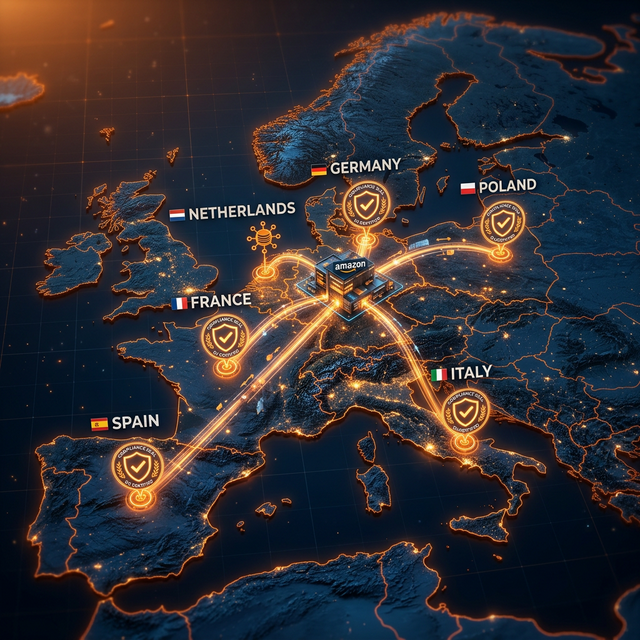
Amazon Pan-European FBA distributes your inventory across fulfilment centres in Germany, France, Italy, Spain, Poland, Netherlands, and the Czech Republic to improve delivery speed and reduce shipping costs. The programme is commercially powerful — but it creates an EPR compliance obligation in every country where your inventory is stored or sold. Without valid WEEE, battery, and packaging registrations in each country, your Pan-EU expansion is a compliance liability waiting to trigger multi-market suspensions.
Why Pan-EU Creates Multi-Country EPR Obligations
EPR obligations are triggered by placing products on a national market. Under EU law, placing a product on the market includes storing inventory in a country for the purpose of sale — even if the product has not yet been purchased by a consumer. When Amazon distributes your FBA inventory to warehouses in Germany, France, Italy, Spain, Poland, and the Netherlands, you are legally placing products on each of those national markets simultaneously.
This means you need separate EPR registrations in every country where Amazon holds your stock. A UK-based seller enrolled in Pan-EU who sells electronics could need WEEE registration in up to six countries, plus packaging EPR in each country (all products ship in packaging), plus battery EPR if products contain batteries. The total obligation can span three EPR streams across six countries — eighteen separate registrations managed through six different national authorities.
Many sellers enrol in Pan-EU for the logistics benefits without understanding the compliance implications. Inventory distributed across multiple countries without valid registrations leaves the seller exposed to listing suspensions, fines, and customs seizure in every affected market.
EPR Registrations Required Per Country
Germany — Stiftung EAR, LUCID, Battery Register
WEEE registration with Stiftung EAR (mandatory authorised representative for non-EU sellers), LUCID packaging registration with a dual system contract, and battery registration if applicable. Germany has the strictest enforcement — Amazon validates WEEE-Reg.-Nr. numbers against Stiftung EAR in real time. Full Germany guide →
France — ADEME, SYDEREP, Eco-Organisms
SYDEREP registration with ADEME, eco-organism membership for WEEE (Ecosystem or Ecologic), packaging (Citeo or Léko), and batteries (Corepile or Screlec). France has the broadest EPR scope in the EU following the AGEC law. Full France guide →
Italy — RAEE, CONAI, Battery Scheme
RAEE producer registration with a collective scheme, CONAI membership for packaging, battery scheme enrolment. Italy uses open scope — virtually all electrical products fall within RAEE. Full Italy guide →
Spain — SIG, Ecoembes, Battery SIG
Registro Integrado Industrial registration, SIG membership for WEEE (Ecotic, Ecolec, or others), Ecoembes for packaging. Regional Autonomous Communities also conduct enforcement. Full Spain guide →
Netherlands — Wecycle, Afvalfonds, Stibat
WEEE PRO registration (Wecycle or Stichting Open), Afvalfonds Verpakkingen for packaging, Stibat for batteries. Cross-border enforcement with Germany and Belgium is active. Full Netherlands guide →
Poland — BDO System, Collection Organisations
BDO registration, WEEE collection organisation, packaging recovery organisation, battery scheme. Poland is the fastest growing EU Amazon marketplace with tightening enforcement. Full Poland guide →
The Enforcement Timeline Across EU Marketplaces
Amazon has rolled out EPR enforcement progressively. Germany led with strict WEEE number validation from 2023. France, Italy, and Spain followed with increasing compliance checks through 2024 and 2025. Netherlands and Poland are in earlier enforcement stages but tightening rapidly.
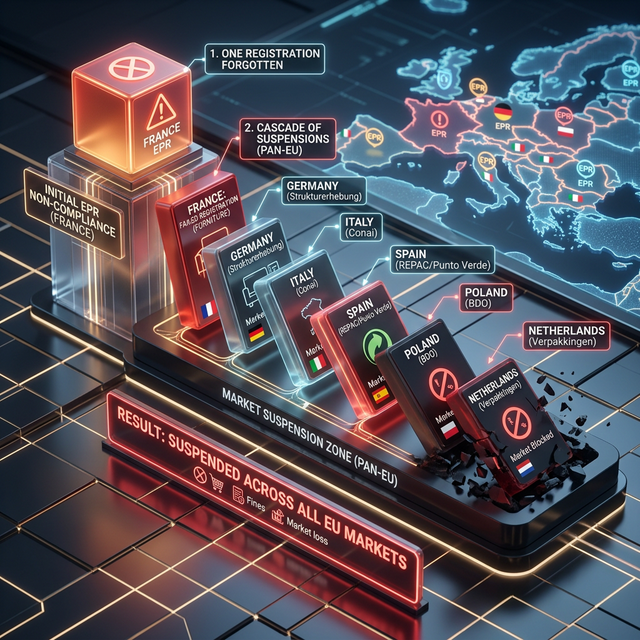
The pattern is consistent across every marketplace: voluntary compliance, then soft warnings, then automated enforcement with listing suspensions. Sellers who registered early in Germany but delayed other markets are seeing suspensions cascade across their Pan-EU footprint as each marketplace matures its enforcement systems.
Waiting for enforcement to catch up is not a viable strategy. By the time Amazon suspends listings, the damage to search rankings and sales velocity has already begun — and recovery takes weeks even after compliance is established.
Common Pan-EU Compliance Mistakes
Assuming German registration covers other countries
It does not. EPR is a national obligation. Registration with Stiftung EAR is valid only for Germany. France, Italy, Spain, Netherlands, and Poland each require separate national registrations with their own authorities.
Relying on Amazon Pay on Behalf outside Germany
Pay on Behalf handles eco-fees in some markets but does not provide producer registration numbers. When Amazon tightens enforcement — and it does, progressively — sellers without their own numbers face suspension even if Pay on Behalf was handling their fees. See our Pay on Behalf comparison for the full breakdown.
Registering for WEEE but ignoring packaging
Every product shipped through FBA arrives in packaging. Packaging EPR is a separate obligation in every EU country. Germany requires LUCID registration regardless of product type. Sellers who register only for WEEE remain exposed on packaging compliance and face separate enforcement actions.
Ignoring battery EPR
Any product containing a battery — lithium-ion cells in electronics, disposable batteries in toys, rechargeable batteries in personal care devices — triggers separate battery producer registration under EU Regulation 2023/1542. This is a distinct obligation from WEEE, with separate registration and reporting requirements.
How Eldris Simplifies Pan-EU Compliance
Eldris covers all six major Pan-EU countries through a single onboarding process. One form captures your business details, product categories, and estimated volumes for all countries and all EPR streams simultaneously. WEEE, battery, and packaging registrations are submitted to each national authority in parallel.
There is no monthly fee: each registration is one annual fee per country, with unlimited SKUs and annual reporting included. For Pan-EU sellers, registering in four to six countries takes 5% off the total automatically (10% from seven countries, 15% from ten).
Frequently Asked Questions
Do I need EPR registration in every Pan-EU country?
Yes. Pan-EU distributes inventory across multiple countries, creating a legal obligation to register in each one. If Amazon holds your stock in Germany, France, Italy, Spain, Poland, and the Netherlands, you need registration in all six.
What if I only sell on Amazon.de but use Pan-EU distribution?
If your inventory is stored in other countries' fulfilment centres, you likely have EPR obligations there. The legal trigger is placing products on the national market, which includes storage for the purpose of sale — regardless of where the buyer is located.
Can I restrict inventory placement to avoid EPR in some countries?
You can manage inventory placement settings in Seller Central to limit which countries receive your stock. However, this reduces the logistics benefits of Pan-EU. Most sellers find it more cost-effective to register across all markets and benefit from full distribution coverage.
How much does full Pan-EU EPR compliance cost with Eldris?
WEEE registration in all six countries (Germany, France, Italy, Spain, Poland and the Netherlands) costs £3,590 a year with Eldris after the automatic 5% multi-country discount, including the Poland packaging registration that Poland WEEE requires. Adding battery EPR in the same six countries brings it to £5,650 a year, and adding German (LUCID) packaging to £5,825. There is no monthly fee; annual reporting is included.
Sources
- Directive 2012/19/EU on waste electrical and electronic equipment (WEEE) EUR-Lex
- Regulation (EU) 2023/1542 on batteries and waste batteries EUR-Lex
- Regulation (EU) 2025/40 on packaging and packaging waste (PPWR) EUR-Lex
- Eldris prices and average registration times: the Eldris price list
EPR registration from £185 per country per year, annual reporting included and the authorised representative arranged where the law requires one.
Packaging, electronics (WEEE) and batteries in 29 countries. Average registration time runs from 1 week (Germany packaging) to 9–17 weeks (Greece), or 4–5 months for Spain packaging without a Spanish tax number. See every price
Get my exact priceBased outside the EU? The products you sell there also need a Responsible Person in the EU, a separate duty from EPR: EU & UK Responsible Person, £195 per market, one-off, then from £19.95 a month.
Appoint your Responsible PersonAlso from Eldris
Cosmetics compliance: CPSR, PIF and CPNP
The safety report (CPSR), the product information file (PIF) and the EU notification (CPNP) that every cosmetic product needs before it is sold in the EU, produced for you at a fixed price per product.
Who it is for: Skincare, haircare, fragrance and make-up brands selling into the EU or UK, including Amazon and TikTok Shop sellers.
£195 per formula, £39.95 per variation; CPNP filing £99 per CPSR
Get your CPSR and PIFEU & UK compliance consultation
A fixed-price written report on what applies to your product in each market, what is missing and what to do next, with email follow-ups. Eldris then does the work if you want it to.
Who it is for: Any seller unsure what their product needs, before a launch or after a marketplace asks for documents.
£195 for 3 markets, £295 for 6, £495 for EU 27 + UK
Start a consultation